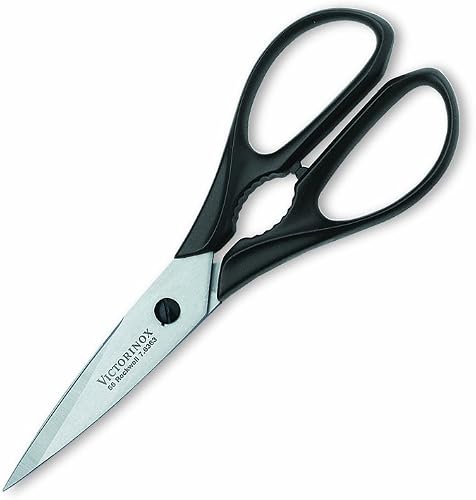
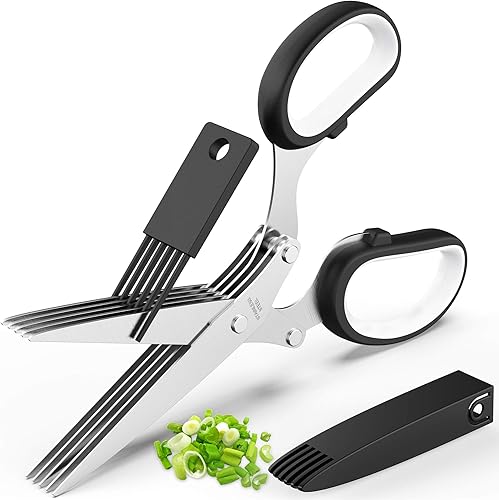
What makes kitchen shears "heavy duty"?
Heavy-duty kitchen shears differ from standard kitchen scissors in three ways: blade gauge (thickness), blade material grade and pivot joint construction. Standard kitchen scissors use stamped stainless blades in the 18 to 20 gauge range. Heavy-duty shears use thicker blade stock, often forged rather than stamped, which provides more cutting force for the same hand effort. Forged blades (Wusthof, Zwilling) are shaped under pressure rather than cut from sheet metal; this aligns the steel's grain structure with the blade edge and produces a harder, longer-lasting edge than stamped blades at the same steel grade. The pivot joint on heavy-duty shears is also more durable: a thicker screw assembly that does not flex under the increased torque of bone-cutting. The bone notch, present on most heavy-duty shears, provides mechanical advantage specifically for the hard cuts (joint bones) by applying cutting force at a point closer to the pivot where force output is greatest. A heavy-duty pair of kitchen shears costs $28 to $40; the upgrade pays off for home cooks who spatchcock, joint poultry or break down shellfish regularly.
Are heavy duty kitchen shears worth it for home cooks?
Heavy-duty kitchen shears are worth the upgrade over standard scissors for home cooks who regularly perform two tasks: spatchcocking whole chickens and cutting through thick poultry joints (thighs from the carcass, drumsticks from the hip joint). Both tasks require cutting through bone with sustained force that can damage the pivot joint on standard-weight kitchen scissors over repeated use. For home cooks who only occasionally cut chicken pieces, a standard pair of OXO Good Grips at $15 handles most cuts adequately. The practical threshold: if you prepare whole chickens more than once per month or regularly break down larger birds (duck, turkey), heavy-duty shears from Wusthof or Victorinox at $28 to $30 are the better long-term investment because standard scissors fail at the joint when repeatedly stressed beyond their design rating. If cutting chicken is infrequent or limited to pre-jointed cuts (boneless thighs, wings), standard kitchen scissors suffice.
How do I sharpen heavy duty kitchen shears?
Heavy-duty kitchen shears with forged blades sharpen with the same methods as kitchen knives: a ceramic rod, a sharpening steel or a whetstone applied to the flat outer face of each blade. The key difference from standard scissors: forged blades (Wusthof, Zwilling) hold their edge significantly longer than stamped blades and require sharpening less frequently. For standard heavy-duty shears: the flat outer blade face is the sharpening surface. Hold the blade at approximately 20 to 25 degrees to the rod or stone and draw it from the shoulder (where the blade meets the handle) to the tip. The number of strokes determines how much metal is removed: for maintenance sharpening (blade still cuts but has lost some sharpness), 4 to 6 strokes per side is sufficient. For a blade that no longer cuts cleanly, 10 to 15 strokes per side is the starting point. Professional sharpening services use belt grinders to restore heavily worn shears more precisely than home methods; for $10 to $15 per pair, this is worthwhile every 2 to 3 years for shears used for bone-cutting.