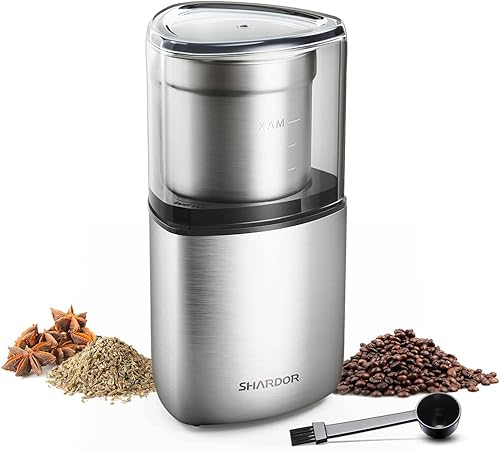
Electric burr mills and blade grinders for whole peppercorns, cumin, coriander and spice blends.
Freshly ground spices release more volatile aromatics than pre-ground spices because the essential oils begin evaporating as soon as the cell walls are broken. A dedicated spice grinder keeps spice oils out of coffee grounds when both are used in the same household. A blade grinder (the same mechanism as a blade coffee grinder) produces an uneven particle size; some spice pieces will be powder while others remain as coarse flakes. A burr grinder produces a more consistent particle size. For most home cooking, a blade grinder at to is sufficient; for specific spice blends where particle consistency matters (ras el hanout, garam masala), a burr mill produces better results. This section covers spice grinders by mechanism, capacity and whether they are dedicated spice-only or dual-purpose.
Commercial spice grinders are evaluated by motor power (500 watts and above handles hard whole spices at volume), grinding chamber capacity (large batches require larger hoppers), durability rating (commercial-grade components rated for continuous duty cycles), NSF certification and price.
Electric spice grinders are evaluated by bowl capacity (2 to 4 ounces covers most home recipes), motor power (150 to 200 watts is adequate for most whole spices), whether the bowl is removable and dishwasher safe for easy cleaning between different spices and price.
Manual spice grinders are evaluated by grinding mechanism (ceramic burr vs steel burr), adjustable coarseness settings, ease of filling and cleaning the grinding chamber, handle comfort for sustained grinding and price.
Mortars and pestles are evaluated by material (granite is heavy and produces the most grinding friction, marble is decorative but less grippy, ceramic is light but may be too smooth), bowl size (at least 3-cup capacity for most recipes), interior surface texture (rough grinds faster than polished) and price.
Pepper grinders are evaluated by grinding mechanism durability (carbon steel vs ceramic vs hardened steel), coarseness adjustment range (fine table pepper to coarse cracked pepper for steak), refill ease, body material and price.
Small-batch spice grinders are evaluated by bowl size (1 to 2 ounces for single-recipe grinding vs 3 to 4 ounces for larger batches), how easy the bowl is to empty completely without wasting ground spice, cleaning ease between different spices and price.
Spice grinders are evaluated by grinding mechanism (blade grinders are inexpensive and fast but inconsistent, burr grinders produce uniform particle size), capacity (how much spice per batch), ease of cleaning (removable bowls vs fixed) and price.