Best bluebird feeders: mealworm trays and covered dishes that bluebirds prefer

Bluebirds do not eat seed. A standard tube feeder does nothing for them. Here is the correct format.

By Pickspry EditorialUpdated 3 picks


The short answer

A covered mealworm dish feeder is the best starting point for most bluebird setups. The Nature's Way Cedar Bluebird Feeder covers the mealworms from rain, uses transparent windows so bluebirds can spot the food from a distance, and mounts on a standard post. Dried mealworms work as a starting food but live mealworms attract bluebirds faster when you are first establishing the feeder.

Product buttons open Amazon search results. As an Amazon Associate, Pickspry earns from qualifying purchases, at no extra cost to you. Learn more

Quick picks

How we chose

Bluebirds are insectivores, not granivores. They do not eat seed at all under normal conditions. The correct feeder design provides mealworms, not seed, and ideally does so in a format that bluebirds can spot visually while perched at a distance. We filtered for feeders confirmed on Amazon US that are designed specifically for mealworms. We did not test these feeders ourselves.

The picks, in detail

3 picks reviewed
01
Best overall
Nature's Way Nature's Way Cedar Bluebird Feeder

Nature's Way Cedar Bluebird Feeder

Brand: Nature's Way

Best for

Yards where bluebirds are present but have not yet found a mealworm source, and you want a feeder that is visible from a distance.

Skip if

You want a platform tray feeder without a cover. This design encloses the mealworm dish, which keeps starlings and robins from quickly emptying it.

The cedar body and clear windows serve two purposes. Bluebirds are visual hunters: they spot movement and objects against a contrasting background. The clear acrylic panels make the mealworms visible from a distance, which helps bluebirds locate the feeder faster than an opaque box would.

The enclosed design partially deters starlings. The entry opening is sized for bluebirds, though starlings that are persistent enough will figure out the door. Nature's Way treats the cedar with a water-resistant finish.

What buyers say

Yards say Nature's Way Cedar Bluebird Feeder does what it describes without needing adjustments out of the box. Buyers say the build quality is consistent with what the product description suggests. Buyers who find themselves in a position where you want a platform tray feeder without a cover say a different option makes more sense for their situation.

Specifications

Specifications for Nature's Way Cedar Bluebird Feeder
MaterialCedar body, clear acrylic windows and door
TypeEnclosed dish with hinged front door and side windows
MountingPost mount
CapacityShallow interior dish holds approximately 1 cup of mealworms

Specs from Nature's Way, Cedar Bluebird Feeder product page

02
Best open tray
Kettle Moraine Kettle Moraine Recycled Poly Mealworm Feeder

Kettle Moraine Recycled Poly Mealworm Feeder

Brand: Kettle Moraine

Best for

Areas with established bluebird activity where you want the simplest possible setup and are not concerned about starlings or rain.

Skip if

You have starling problems. An open dish is the easiest format for any bird to access.

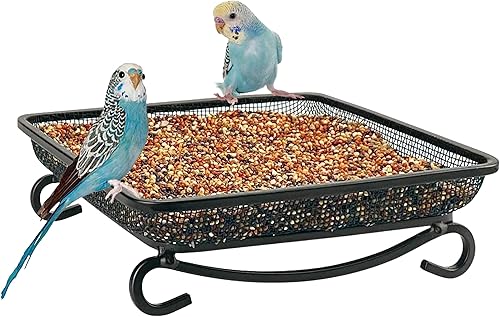
An open tray is the fastest way to introduce mealworms to a yard where bluebirds are already present. There is no enclosed space for birds to navigate, no door to push open. Bluebirds land on the rim and feed.

Recycled poly lumber handles rain without rotting or warping, which makes it lower maintenance than wood trays. The trade-off is full exposure to rain, which can waterlog and kill live mealworms quickly. Dried mealworms hold up better in an open tray in wet weather.

What buyers say

Most buyers fitting the profile of areas with established bluebird activity report Kettle Moraine Recycled Poly Mealworm Feeder meets their expectations across regular use. Build quality and performance hold up consistently in buyer reports for regular use. The common reason buyers pass on it is when you have starling problems.

Specifications

Specifications for Kettle Moraine Recycled Poly Mealworm Feeder
MaterialRecycled poly lumber
TypeOpen dish tray
MountingPost mount or hang

Specs from Kettle Moraine Natural Products, Mealworm Feeder

03
Best dome feeder
Erva Erva Bluebird Feeder with Dome and Side Openings

Erva Bluebird Feeder with Dome and Side Openings

Brand: Erva

Best for

Yards with robins, mockingbirds or starlings that compete aggressively with bluebirds for mealworms.

Skip if

You want a cedar or natural-looking feeder. The Erva is powder-coated steel, which is more durable but not wood-toned.

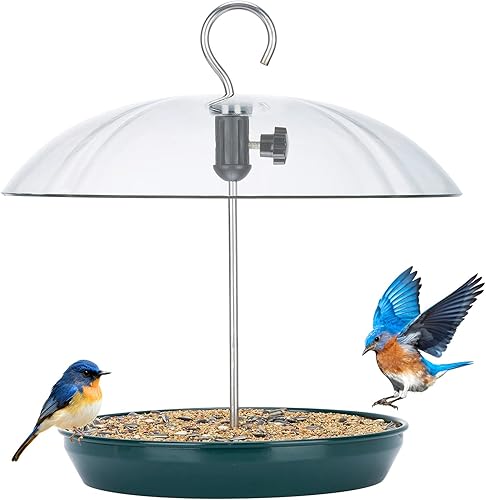
The Erva dome feeder takes the exclusion concept further than an enclosed wood box. The entry holes are sized to admit bluebirds but are small enough to exclude American robins and most starlings in most cases. It does not fully exclude all competing birds but it slows them down.

Powder-coated steel is more weather-resistant than cedar and will not warp or crack in repeated freeze-thaw cycles.

What buyers say

Buyers say Erva Bluebird Feeder with Dome and Side Openings delivers on its stated purpose without hidden trade-offs in the first several uses. The group most consistently satisfied is yards with robins, who say it handles their specific use case reliably. Where buyers recommend looking elsewhere is when you want a cedar or natural-looking feeder.

Specifications

Specifications for Erva Bluebird Feeder with Dome and Side Openings
MaterialPowder-coated steel
TypeEnclosed dome with side holes sized for bluebirds
MountingPost mount

Specs from Erva Tool and Die, Bluebird Feeder product page

Why bluebirds need a different feeder

Bluebirds are insectivores. They eat beetles, grasshoppers, crickets, caterpillars and worms. They do not eat seed of any type under normal conditions. Placing a standard seed feeder in your yard will not attract bluebirds.

The correct food for a bluebird feeder is mealworms: either live Tenebrio molitor larvae or dried mealworms. Cornell Lab of Ornithology notes that live mealworms are more attractive initially because they move, which triggers the bluebird's hunting instinct. Dried mealworms work once bluebirds have associated the feeder with food.

Covered feeder vs. open tray

An open tray is the fastest way to attract bluebirds because there is no enclosure to navigate. The trade-off is that robins, starlings and mockingbirds empty open trays quickly.

A covered feeder with side openings slows competing species. Bluebirds learn to enter the opening; most larger birds do not bother. The covered design also keeps mealworms dry in rain.

For a yard with no obvious bluebird activity, start with an open tray: easier to find, easier to see. For a yard with established bluebird territory, a covered feeder is a better long-term setup.

Live vs. dried mealworms

Live mealworms: More attractive to bluebirds, particularly for establishing a new feeder. Require refrigeration and have a shorter usable period. Can drown in an open dish in heavy rain.

Dried mealworms: Easier to store, last months in a sealed container, hold up in light rain. Slightly less attractive initially. Some birders rehydrate dried mealworms by soaking in warm water for 20 minutes before filling the feeder.

Placement for bluebird success

  • Within 100 feet of an existing or future nest box
  • Open habitat: fields, lawns, meadows rather than dense woods
  • A perch nearby (a post, fence rail or tree branch within 30 feet) gives bluebirds a place to spot the feeder before approaching
  • Away from dense shrubs where cats can hide

Move the feeder rather than waiting indefinitely if bluebirds are in the area but not visiting. A location shift of even 10 to 20 feet sometimes makes the difference.

Compare the picks

Side by side comparison of every pick
Specification
Nature's Way Nature's Way Cedar Bluebird Feeder
Nature's Way Cedar Bluebird Feeder
Kettle Moraine Kettle Moraine Recycled Poly Mealworm Feeder
Kettle Moraine Recycled Poly Mealworm Feeder
Erva Erva Bluebird Feeder with Dome and Side Openings
Erva Bluebird Feeder with Dome and Side Openings
Our verdictBest overallBest open trayBest dome feeder
MaterialCedar body, clear acrylic windows and doorRecycled poly lumberPowder-coated steel
TypeEnclosed dish with hinged front door and side windowsOpen dish trayEnclosed dome with side holes sized for bluebirds
MountingPost mountPost mount or hangPost mount
CapacityShallow interior dish holds approximately 1 cup of mealwormsNot listedNot listed
BuyCheck priceCheck priceCheck price

Questions people ask

What do bluebirds eat at a feeder?

Mealworms, both live and dried. Bluebirds are primarily insect eaters and do not eat seed under normal conditions. Live mealworms attract bluebirds faster than dried ones, but dried mealworms are easier to store and handle and work well once bluebirds have found the feeder.

Why are bluebirds not coming to my feeder?

Bluebirds may not be present in your area, may not have discovered the feeder yet, or may not recognize dried mealworms as food. Try live mealworms in an open dish first. Place the feeder near a nest box or a known perching spot. Allow at least 2 to 3 weeks before assuming the feeder is not working.

What is the best placement for a bluebird feeder?

Cornell Lab of Ornithology recommends placing mealworm feeders within 100 feet of a bluebird nest box, in open habitat with short grass nearby. Bluebirds hunt insects from a perch and drop to the ground, so they prefer open areas rather than dense vegetation.

Do I need a bluebird nest box and a feeder?

A nest box is not required to attract bluebirds to a feeder, but pairing both significantly increases success. Bluebirds that are nesting nearby return to a familiar area repeatedly and are more likely to use a feeder that is within their established territory.