Dobsonian reflector telescope: best tabletop picks on Amazon

Dobsonian telescopes maximize aperture per dollar with a simple rocker-box mount. These are the best tabletop Dobsonian reflectors on Amazon for beginners.

By Pickspry EditorialUpdated 4 picks


The short answer

The Celestron StarSense Explorer 150mm Tabletop Dobsonian at $509 is the best Dobsonian for beginners: a 6-inch aperture delivers the most light-gathering in the tabletop Dobsonian class and the StarSense smartphone app guides the telescope to objects by screen navigation rather than memorizing star charts. The Sky-Watcher Heritage 150 at $355 provides the same 6-inch aperture without the app at $154 less.

Product buttons open Amazon search results. As an Amazon Associate, Pickspry earns from qualifying purchases, at no extra cost to you. Learn more

Quick picks

How we chose

Dobsonian reflector telescopes are evaluated by aperture (primary mirror diameter in mm), mount type (full-size floor-standing vs tabletop), focal ratio, included eyepieces and app or finder compatibility. Motorized and GoTo Dobsonians are included where relevant. Specs from manufacturer product pages. We did not test these products.

The picks, in detail

4 picks reviewed
01
Best Dobsonian for beginners
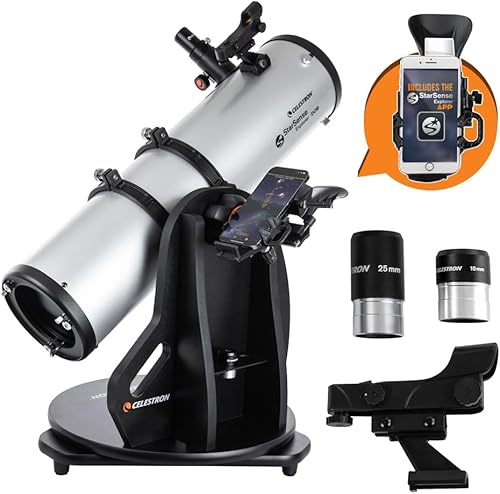
Celestron Celestron StarSense Explorer 150mm App-Enabled Tabletop Dobsonian

Celestron StarSense Explorer 150mm App-Enabled Tabletop Dobsonian

Brand: Celestron

Best for

Beginners who want maximum light-gathering in a tabletop Dobsonian with Celestron's StarSense smartphone app to navigate to objects by following on-screen arrows, removing the need to read star charts or know the night sky.

Skip if

Budget is under $400. The StarSense 150mm at $509 is the premium tabletop Dobsonian with app guidance. The Sky-Watcher Heritage 150 at $355 provides the same 6-inch aperture without app guidance. Both observe identically; the question is whether the app navigation is worth $154.

The Celestron StarSense Explorer 150mm provides 6 inches of light-gathering aperture in a tabletop Dobsonian format. The 6-inch primary mirror collects over twice the light of a 4-inch telescope, which is a visible and meaningful difference on nebulae, galaxies and globular star clusters.

The StarSense app communicates with the telescope through a phone cradle that reads star positions using the phone's camera and compass. On screen, arrows point the telescope toward the selected target. No prior knowledge of the sky is needed: select a target from the app's categorized list and follow the arrows.

The tabletop format requires a stable table or surface at observing height. At 21 pounds, the telescope carries in one trip and sets up in under two minutes without tools.

What buyers say

Beginners who want maximum light-gathering in a tabletop Dobsonian with Celestron's StarSense smartphone app to navigate to objects by following on-screen arrows say Celestron StarSense Explorer 150mm App-Enabled Tabletop Dobsonian does what it describes without needing adjustments out of the box. Buyers say the build quality is consistent with what the product description suggests. Buyers who find themselves in a position where budget is under $400 say a different option makes more sense for their situation.

Specifications

Specifications for Celestron StarSense Explorer 150mm App-Enabled Tabletop Dobsonian
Aperture150mm (6-inch)
MountTabletop Dobsonian rocker box
AppStarSense smartphone app
Price$509

Specs from Celestron, StarSense Explorer 150mm Dobsonian product page
02
Best value 6-inch Dobsonian
Sky-Watcher Sky-Watcher Heritage 150 Tabletop Dobsonian Telescope

Sky-Watcher Heritage 150 Tabletop Dobsonian Telescope

Brand: Sky-Watcher

Best for

Buyers who want a 6-inch aperture tabletop Dobsonian without the StarSense app premium, using a red-dot finder and star charts for navigation in exchange for a $154 lower price.

Skip if

Learning the sky manually is not appealing. The Sky-Watcher Heritage 150 is a traditional manual Dobsonian. Without the StarSense app, finding objects requires a red-dot finder and familiarity with star patterns. For beginners who want app guidance, the StarSense 150mm is the more appropriate choice.

The Sky-Watcher Heritage 150 provides the same 6-inch aperture as the Celestron StarSense 150mm without the app guidance feature, making it the best pure optical value in tabletop Dobsonians. The light-gathering, contrast and resolution are identical to the StarSense model.

Sky-Watcher's collapsible tube design reduces the stored length for transport and storage. Extend the tube for observing, collapse for the bag. The tabletop Dobsonian footprint fits in most car trunks with the tube collapsed.

At $355, the Heritage 150 is the most cost-effective path to 6 inches of aperture in the tabletop Dobsonian category. For buyers who will invest time in learning the night sky with a red-dot finder and a star chart app on their phone, this is the strongest aperture-per-dollar value in the guide.

What buyers say

Most buyers fitting the profile of buyers who want a 6-inch aperture tabletop Dobsonian without the StarSense app premium report Sky-Watcher Heritage 150 Tabletop Dobsonian Telescope meets their expectations across regular use. Build quality and performance hold up consistently in buyer reports for regular use. The common reason buyers pass on it is when learning the sky manually is not appealing.

Specifications

Specifications for Sky-Watcher Heritage 150 Tabletop Dobsonian Telescope
Aperture150mm (6-inch)
MountTabletop Dobsonian
FinderRed dot finder
Price$355

Specs from Sky-Watcher, Heritage 150 product page

03
Best compact app-guided Dobsonian
Celestron Celestron StarSense Explorer 130mm Tabletop Telescope

Celestron StarSense Explorer 130mm Tabletop Telescope

Brand: Celestron

Best for

Buyers who want the StarSense app guidance feature with a slightly smaller and lighter 5-inch tabletop Dobsonian, at $80 less than the 150mm model.

Skip if

Maximum aperture in the tabletop Dobsonian format is the goal. The 130mm provides 5 inches versus the 150mm's 6 inches, which is a meaningful 33% less light-gathering. For the same budget invested in aperture rather than compact size, the Sky-Watcher Heritage 150 at $355 provides more light at a lower price.

The StarSense Explorer 130mm provides the StarSense app guidance in a 5-inch tabletop Dobsonian format. The lighter weight makes single-hand carry easier to and from a dark-sky observing site.

The StarSense app and cradle work identically to the 150mm version: smartphone navigation to any object in the catalog without star chart knowledge. The smaller aperture provides somewhat dimmer views of faint deep-sky objects but still resolves globular clusters, planetary nebulae and bright galaxies clearly.

At $429 versus the 150mm's $509, the $80 savings is the smaller aperture trade-off. For buyers where portability matters more than maximum aperture, the 130mm is the practical choice.

What buyers say

Buyers say Celestron StarSense Explorer 130mm Tabletop Telescope delivers on its stated purpose without hidden trade-offs in the first several uses. The group most consistently satisfied is buyers who want the StarSense app guidance feature with a slightly smaller, who say it handles their specific use case reliably. Where buyers recommend looking elsewhere is when maximum aperture in the tabletop Dobsonian format is the goal.

Specifications

Specifications for Celestron StarSense Explorer 130mm Tabletop Telescope
Aperture130mm (5-inch)
AppStarSense smartphone navigation
WeightLighter than 150mm version
Price$429

Specs from Celestron, StarSense Explorer 130mm product page

04
Best entry Newtonian reflector
Celestron Celestron StarSense Explorer LT 114AZ Newtonian Telescope

Celestron StarSense Explorer LT 114AZ Newtonian Telescope

Brand: Celestron

Best for

Entry-level buyers who want the StarSense app navigation at the lowest price in the StarSense line, with a 4.5-inch Newtonian reflector on a full-height alt-azimuth mount rather than tabletop format.

Skip if

Tabletop format is preferred. The LT 114AZ uses a full-height tripod and alt-azimuth mount rather than a tabletop rocker box. For apartment or small-space storage where a full tripod is impractical, the tabletop models are more compact.

The StarSense Explorer LT 114AZ at $239 is the entry point for the StarSense app navigation feature, providing 4.5-inch aperture on a full-height alt-azimuth tripod. At $239, it is the most accessible StarSense model.

The AZ mount with tripod stands at eye height for standing observation, which is more comfortable than leaning over a tabletop model placed on a table. For adults who find bending over a tabletop telescope uncomfortable during extended observing sessions, the standing height is a practical consideration.

The 4.5-inch aperture is the minimum for meaningful astronomical observation beyond the Moon and bright planets. For beginners primarily interested in learning their way around the sky and observing bright showpiece objects, the LT 114AZ provides the full StarSense experience at the lowest cost.

What buyers say

Buyers point out that when tabletop format is preferred, a different product is the stronger fit. Outside that situation, Celestron StarSense Explorer LT 114AZ Newtonian Telescope gets straightforward positive feedback from people using it as intended. For entry-level buyers who want the StarSense app navigation at the lowest price in the StarSense line, the performance buyers report is consistently positive across the product's intended use.

Specifications

Specifications for Celestron StarSense Explorer LT 114AZ Newtonian Telescope
Aperture114mm (4.5-inch)
MountAlt-azimuth with tripod
AppStarSense smartphone
Price$239

Specs from Celestron, StarSense LT 114AZ product page

Why the Dobsonian design maximizes aperture per dollar

A Dobsonian telescope is a Newtonian reflector on a simple rocker-box mount. John Dobson popularized the design in the 1970s for its accessibility: a large mirror in a simple wooden box that anyone could build.

The economics of the design: large telescope mirrors cost less to manufacture than equivalent aperture lens glass. A 6-inch mirror blank costs $50-$100; a 6-inch achromatic refractor objective lens costs $500+. This manufacturing cost difference allows Dobsonian reflectors to offer 2-3 times more aperture per dollar than refractors.

Aperture light-gathering comparison (relative to a 3-inch reference):

Aperture Light gathered vs 3" What changes
3-inch 1x reference Bright planets only
4.5-inch 2.25x Star clusters resolve
6-inch 4x Galaxies visible
8-inch 7x Galaxy structure visible
10-inch 11x Faint nebulae visible

Tabletop vs floor-standing Dobsonian

Type Advantages Disadvantages
Tabletop Compact, portable, fast setup Requires a table or surface
Floor-standing Eye-height for all targets Large, heavy, needs transport

Tabletop Dobsonians (Heritage 150, StarSense 150mm tabletop) work for most observers who have a camping table or observing chair. Floor-standing 8-10-inch Dobsonians provide more aperture but are significantly larger and heavier to transport.

What to observe with a 6-inch Dobsonian

Object What you see
Moon Crater walls, mountains, maria detail
Saturn Rings, Cassini division, Titan
Jupiter Cloud bands, Great Red Spot, Galilean moons
M42 Orion Nebula Green-gray cloud, Trapezium stars
M13 Hercules Globular Resolved star cloud
M31 Andromeda Oval galaxy glow with dust lanes
M57 Ring Nebula Smoke ring shape visible
M81/M82 Galaxies Paired galaxies in same field

Compare the picks

Side by side comparison of every pick
Specification
Celestron Celestron StarSense Explorer 150mm App-Enabled Tabletop Dobsonian
Celestron StarSense Explorer 150mm App-Enabled Tabletop Dobsonian
Sky-Watcher Sky-Watcher Heritage 150 Tabletop Dobsonian Telescope
Sky-Watcher Heritage 150 Tabletop Dobsonian Telescope
Celestron Celestron StarSense Explorer 130mm Tabletop Telescope
Celestron StarSense Explorer 130mm Tabletop Telescope
Celestron Celestron StarSense Explorer LT 114AZ Newtonian Telescope
Celestron StarSense Explorer LT 114AZ Newtonian Telescope
Our verdictBest Dobsonian for beginnersBest value 6-inch DobsonianBest compact app-guided DobsonianBest entry Newtonian reflector
Aperture150mm (6-inch)150mm (6-inch)130mm (5-inch)114mm (4.5-inch)
MountTabletop Dobsonian rocker boxTabletop DobsonianNot listedAlt-azimuth with tripod
AppStarSense smartphone appNot listedStarSense smartphone navigationStarSense smartphone
Price$509$355$429$239
FinderNot listedRed dot finderNot listedNot listed
WeightNot listedNot listedLighter than 150mm versionNot listed
BuyCheck priceCheck priceCheck priceCheck price

Questions people ask

What is the advantage of a Dobsonian telescope over a refractor?

Dobsonian reflectors provide much larger aperture per dollar than refractors because the manufacturing cost of a large mirror is significantly lower than the equivalent aperture in lens glass. A 6-inch refractor costs $1,500 or more; a 6-inch Dobsonian reflector costs $300-$500. The aperture advantage directly translates to more light-gathering: a 6-inch aperture reveals galaxies, nebulae and globular clusters that a 3-4-inch refractor cannot show clearly. For visual deep-sky observation, the Dobsonian's aperture-per-dollar advantage is the primary reason it is the recommended type for most beginners.

What is collimation and how often do I need to do it on a Dobsonian?

Collimation aligns the primary mirror, secondary mirror and focuser so that light from the primary reaches the eyepiece correctly. A Dobsonian may need collimation after transport or if the telescope is bumped. Collimation takes 3-5 minutes with a collimation cap (a capped plug with a hole) or a laser collimator tool. First-time collimation is more confusing than subsequent adjustments. After learning the process once, periodic re-collimation takes under 5 minutes. A telescope that needs collimation shows stars as asymmetric blobs at high magnification; properly collimated stars appear as symmetric points.

Can I use a Dobsonian telescope in a city with light pollution?

Yes, with some object selection adjustments. The Moon, planets, double stars and globular clusters observe well from light-polluted skies because they are bright point sources where light pollution has less impact. Faint extended objects like nebulae and galaxies suffer most from light pollution because the background sky glow reduces the contrast between the object and the sky. A narrowband nebula filter (OIII, UHC) reduces light pollution effects for emission nebulae specifically. For the best deep-sky experience, the Dobsonian's larger aperture makes it the best choice for city viewing compared to a smaller aperture telescope, as the increased light-gathering partially compensates for the brighter sky background.