Best manual pull-through knife sharpeners: carbide, ceramic and diamond picks

Pull-through sharpeners are the fastest way to get a dull kitchen knife cutting again. Here is what separates the ones that work from the ones that chew up a blade.

By Pickspry EditorialUpdated 4 picks


The short answer

The Chef'sChoice ProntoPro 4643 is the best manual pull-through sharpener for most kitchens. Its three-stage design handles both 15-degree Asian-style knives and 20-degree European knives in separate channels, uses diamond abrasives in the first stage for fast metal removal, and finishes with flexible stropping disks for a clean edge.

Product buttons open Amazon search results. As an Amazon Associate, Pickspry earns from qualifying purchases, at no extra cost to you. Learn more

Quick picks

How we chose

We filtered for manual pull-through sharpeners sold on Amazon US that use fixed-angle abrasive elements rather than relying on the user to hold an angle. Key criteria: abrasive quality (diamond outperforms carbide for controlled metal removal), number of stages, and whether the design handles both common knife edge angles. Specs from manufacturer pages. We did not test these products ourselves.

The picks, in detail

4 picks reviewed
01
Best overall
Chef'sChoice Chef'sChoice ProntoPro 4643

Chef'sChoice ProntoPro 4643

Brand: Chef'sChoice

Best for

Households with both European-style chef knives at 20 degrees and Asian-style knives at 15 degrees, who want one sharpener that handles both without confusion.

Skip if

You want the absolute least expensive option. This is the most expensive manual pull-through sharpener on this list.

The ProntoPro 4643 has separate sharpening channels for 15-degree knives (most Japanese and Asian-style blades) and 20-degree knives (most German and European-style blades). Chef'sChoice labels both clearly so there is no guessing. The first stage uses coarse diamond abrasives to remove metal and establish the bevel; the second stage uses finer diamond abrasives to refine it; the third stage uses a flexible stropping disk to align the edge and remove the wire burr.

Diamond abrasives remove metal more consistently than carbide wheels, which chip and gouge rather than cut cleanly. The edge from this sharpener is noticeably smoother than the edge from a carbide-only pull-through.

What buyers say

Households with both European-style chef knives at 20 degrees and Asian-style knives at 15 degrees say Chef'sChoice ProntoPro 4643 does what it describes without needing adjustments out of the box. Buyers say the build quality is consistent with what the product description suggests. Buyers who find themselves in a position where you want the absolute least expensive option say a different option makes more sense for their situation.

Specifications

Specifications for Chef'sChoice ProntoPro 4643
Stages3 (coarse diamond, fine diamond, stropping disk)
Edge angles15 and 20 degrees (separate channels)
AbrasivesDiamond-coated disks (stages 1 and 2), flexible stropping disk (stage 3)
BodyNon-slip base

Specs from Chef'sChoice, ProntoPro 4643 product page

02
Best budget pick
KitchenIQ KitchenIQ Edge Grip 2-Stage Knife Sharpener

KitchenIQ Edge Grip 2-Stage Knife Sharpener

Brand: KitchenIQ

Best for

Households that want a fast, inexpensive sharpener for European-style kitchen knives and are not concerned about fine edge quality.

Skip if

You have high-quality knives. The carbide stage in this sharpener removes a lot of metal per pass. It is best for inexpensive everyday knives.

The KitchenIQ is the simplest, least expensive manual pull-through sharpener that actually sharpens a dull knife. The carbide first stage is aggressive: it removes metal quickly, which gets a dull knife cutting again in 4 to 5 pulls. The ceramic second stage smooths the edge and removes some of the roughness left by carbide.

The suction cup base keeps it from sliding on a countertop, which is a real safety improvement over pull-through sharpeners that slide around during use.

What buyers say

Most buyers fitting the profile of households that want a fast report KitchenIQ Edge Grip 2-Stage Knife Sharpener meets their expectations across regular use. Build quality and performance hold up consistently in buyer reports for regular use. The common reason buyers pass on it is when you have high-quality knives.

Specifications

Specifications for KitchenIQ Edge Grip 2-Stage Knife Sharpener
Stages2 (carbide, ceramic)
Edge angle20 degrees (European-style)
BaseSuction cup base

Specs from KitchenIQ, Edge Grip Knife Sharpener product listing

03
Best for Asian knives
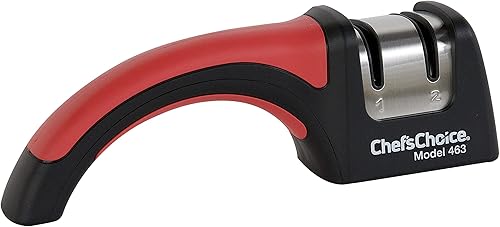
Chef'sChoice Chef'sChoice Pronto Santoku 463

Chef'sChoice Pronto Santoku 463

Brand: Chef'sChoice

Best for

Japanese chef knives, santoku knives, and other 15-degree Asian-style blades where most standard pull-through sharpeners use the wrong angle.

Skip if

Your knives are European-style with a 20-degree bevel. Using a 15-degree sharpener on a 20-degree knife leaves a poor edge.

Most pull-through sharpeners are built around the 20-degree European knife bevel. Using them on a 15-degree Japanese knife produces an edge at the wrong angle. The Santoku 463 is set to 15 degrees, which is the angle used by most Japanese knife manufacturers for santoku, gyuto and nakiri knives.

Two diamond stages without a stropping stage means this sharpener is faster than the ProntoPro but leaves a slightly coarser edge. For kitchen prep use, the difference is negligible.

What buyers say

Buyers say Chef'sChoice Pronto Santoku 463 delivers on its stated purpose without hidden trade-offs in the first several uses. The group most consistently satisfied is japanese chef knives, who say it handles their specific use case reliably. Where buyers recommend looking elsewhere is when your knives are European-style with a 20-degree bevel.

Specifications

Specifications for Chef'sChoice Pronto Santoku 463
Stages2 (coarse diamond, fine diamond)
Edge angle15 degrees
AbrasivesDiamond-coated disks

Specs from Chef'sChoice, Pronto Santoku 463 product page

04
Best three-stage for European knives
Chef'sChoice Chef'sChoice ProntoPro 4623

Chef'sChoice ProntoPro 4623

Brand: Chef'sChoice

Best for

European-style kitchen knives at 20 degrees where you want diamond abrasives and a stropping finish in one tool.

Skip if

You have Asian-style knives. This model is 20-degree only.

The 4623 is the same concept as the ProntoPro 4643 but built for 20-degree European knives only, without the 15-degree channel. If your kitchen is all European-style knives, this is the cleaner purchase: same three-stage diamond sharpening process, single-angle design, lower price than the dual-angle 4643.

What buyers say

Buyers point out that when you have Asian-style knives, a different product is the stronger fit. Outside that situation, Chef'sChoice ProntoPro 4623 gets straightforward positive feedback from people using it as intended. For european-style kitchen knives at 20 degrees, the performance buyers report is consistently positive across the product's intended use.

Specifications

Specifications for Chef'sChoice ProntoPro 4623
Stages3 (coarse diamond, fine diamond, stropping)
Edge angle20 degrees
AbrasivesDiamond-coated disks (stages 1 and 2), stropping disk (stage 3)

Specs from Chef'sChoice, ProntoPro 4623 product page

What pull-through sharpeners do

A pull-through sharpener holds abrasive elements at a fixed angle while you drag the knife blade through a slot. The fixed angle is the key feature: you do not need to maintain a consistent bevel by hand the way you do with a whetstone. The knife rides in the slot and the sharpener does the angle work.

The trade-off is metal removal. A pull-through sharpener takes off more metal per session than a honing rod or a whetstone, because it is working the edge with a coarser abrasive contact than either of those tools.

Carbide vs. diamond abrasives

Carbide sharpeners use crossed tungsten carbide rods. The knife edge catches between the rods and the rods chip material off rather than cut it. The edge that results is functional but rough, and the process removes a large amount of metal per pass.

Diamond sharpeners use abrasive-coated disks or rods. Diamond cuts rather than chips, so the edge profile is more consistent and finer. The metal removal per pass is more controlled.

For knives you care about, a diamond pull-through is meaningfully better than a carbide one. For inexpensive knives used for cutting tape and opening boxes, the difference does not matter.

Edge angle: why it matters

A 15-degree edge and a 20-degree edge are not interchangeable. Japanese knives are ground to a thinner 15-degree angle to allow a sharper, more precise cutting edge. European knives are ground at 20 degrees, which is a wider angle that holds up to harder use.

Using a 20-degree sharpener on a 15-degree knife creates an edge that is too thick at the apex. The knife will cut, but it will not perform at its design specification. If your knife is marked with a brand like Shun, Global, MAC or Miyabi, look for a 15-degree sharpener.

When to use a whetstone instead

A pull-through sharpener is faster and easier than a whetstone, but it has limits:

  • For chipped or damaged edges, a coarse whetstone is safer because you control exactly how much metal you remove
  • For high-end knives, a whetstone extends blade life by removing less metal per session
  • For a polished, razor-sharp edge, a whetstone followed by a leather strop outperforms any pull-through

Compare the picks

Side by side comparison of every pick
Specification
Chef'sChoice Chef'sChoice ProntoPro 4643
Chef'sChoice ProntoPro 4643
KitchenIQ KitchenIQ Edge Grip 2-Stage Knife Sharpener
KitchenIQ Edge Grip 2-Stage Knife Sharpener
Chef'sChoice Chef'sChoice Pronto Santoku 463
Chef'sChoice Pronto Santoku 463
Chef'sChoice Chef'sChoice ProntoPro 4623
Chef'sChoice ProntoPro 4623
Our verdictBest overallBest budget pickBest for Asian knivesBest three-stage for European knives
Stages3 (coarse diamond, fine diamond, stropping disk)2 (carbide, ceramic)2 (coarse diamond, fine diamond)3 (coarse diamond, fine diamond, stropping)
Edge angles15 and 20 degrees (separate channels)Not listedNot listedNot listed
AbrasivesDiamond-coated disks (stages 1 and 2), flexible stropping disk (stage 3)Not listedDiamond-coated disksDiamond-coated disks (stages 1 and 2), stropping disk (stage 3)
BodyNon-slip baseNot listedNot listedNot listed
Edge angleNot listed20 degrees (European-style)15 degrees20 degrees
BaseNot listedSuction cup baseNot listedNot listed
BuyCheck priceCheck priceCheck priceCheck price

Questions people ask

Are pull-through knife sharpeners bad for knives?

They remove more metal per session than a whetstone, which shortens knife life over time. Carbide sharpeners are more aggressive than diamond sharpeners. For expensive knives, a whetstone is better for long-term blade health. For everyday kitchen knives, a quality pull-through sharpener with diamond abrasives is a reasonable trade between convenience and metal removal.

How many times should I pull through a sharpener?

In the coarse or first stage, 3 to 5 pulls per side is standard for a dull knife. In the fine or finishing stage, 3 to 4 pulls per side. Stop when the knife cuts paper cleanly. More pulls than needed increases metal removal without improving the edge.

Can I use a pull-through sharpener on a Japanese knife?

Only if the sharpener is designed for the 15-degree angle that most Japanese knives use. Using a standard 20-degree pull-through on a Japanese knife creates an edge at the wrong angle. Chef'sChoice labels angle on all their models, which makes selection straightforward.

Do I still need to hone my knives if I use a pull-through sharpener?

Honing realigns a slightly bent edge and prolongs time between sharpenings. A pull-through sharpener removes metal to create a new edge. They do different things. Using a honing rod between pull-through sessions reduces how often you need to sharpen, which reduces total metal removal over time.