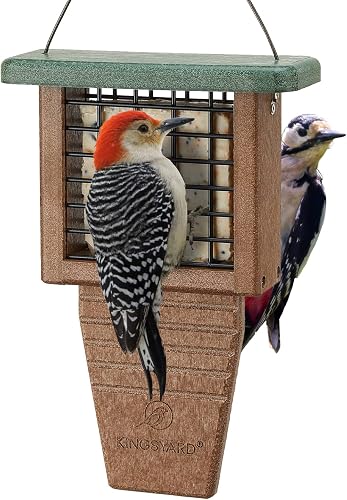
Best suet feeders: cage and tail-prop designs for woodpeckers and clinging birds

Suet feeders attract woodpeckers, nuthatches and other clinging birds that rarely visit seed feeders. Here is what separates a good one from a bad one.

By Pickspry EditorialUpdated 4 picks


The short answer

The Heath Outdoor Products Standard Suet Cage (model DT-6) is the most practical suet feeder. It holds one standard suet cake, has a hinged top for loading, and is coated with vinyl rather than bare metal. The double-suet version (DT-4) holds two cakes and reduces refilling frequency.

Product buttons open Amazon search results. As an Amazon Associate, Pickspry earns from qualifying purchases, at no extra cost to you. Learn more

Quick picks

How we chose

We filtered for suet feeders sold on Amazon US that hold standard 11 oz suet cakes, checked for coated metal construction (bare galvanized wire is harder to clean), and identified designs with tail-prop sections for woodpeckers. Specs from manufacturer pages where available. We did not test these products ourselves.

The picks, in detail

4 picks reviewed
01
Best single-cake suet feeder
Heath Outdoor Products Heath Outdoor Products Standard Suet Cage DT-6

Heath Outdoor Products Standard Suet Cage DT-6

Brand: Heath Outdoor Products

Best for

The most standard entry-level suet feeder for any backyard setup. Works with all standard 11 oz suet cakes.

Skip if

You want a tail-prop for larger woodpeckers. The DT-6 has no extended tail-prop panel. Choose the Heath DT-2 or a dedicated woodpecker feeder instead.

The vinyl coating matters: bare galvanized wire accumulates grease, mold and mildew from suet fat. A vinyl-coated cage wipes clean with a damp cloth. Bare wire cages require more effort to clean and typically need replacement sooner as the wire corrodes.

Standard 11 oz suet cakes fit all retailers: C&S, Wild Birds Unlimited, Brome and Kaytee all make suet cakes in this size. If the feeder does not fit the standard size, you are locked into one brand.

What buyers say

The most standard entry-level suet feeder for any backyard setup. Works with say Heath Outdoor Products Standard Suet Cage DT-6 does what it describes without needing adjustments out of the box. Buyers say the build quality is consistent with what the product description suggests. Buyers who find themselves in a position where you want a tail-prop for larger woodpeckers say a different option makes more sense for their situation.

Specifications

Specifications for Heath Outdoor Products Standard Suet Cage DT-6
Capacity1 standard suet cake (11 oz)
Mesh sizeStandard 1.5 inch wire spacing
ConstructionVinyl-coated wire
LoadingHinged top opens for loading

Specs from Heath Outdoor Products, DT-6 Suet Cage product page

02
Best double-cake suet feeder
Heath Outdoor Products Heath Outdoor Products Double Suet Cake Feeder DT-4

Heath Outdoor Products Double Suet Cake Feeder DT-4

Brand: Heath Outdoor Products

Best for

High-traffic suet feeders visited by multiple woodpeckers and nuthatches daily, where the single cake empties too quickly.

Skip if

You are just starting a suet feeding station. Start with a single-cake feeder and upgrade if demand justifies it.

The tail-prop panel on the bottom of the DT-4 is designed for larger woodpeckers: Hairy woodpeckers, Pileated woodpeckers and Northern Flickers brace their stiff tail feathers against a solid surface below the feeding surface. A feeder without this panel forces them to cling at an awkward angle that reduces their visit time and comfort.

Two cakes also attract multiple birds at once, which reduces competition and allows you to fill both sides with different suet flavors (nut, insect, berry) to observe which birds prefer which.

What buyers say

Most buyers fitting the profile of high-traffic suet feeders visited by multiple woodpeckers report Heath Outdoor Products Double Suet Cake Feeder DT-4 meets their expectations across regular use. Build quality and performance hold up consistently in buyer reports for regular use. The common reason buyers pass on it is when you are just starting a suet feeding station.

Specifications

Specifications for Heath Outdoor Products Double Suet Cake Feeder DT-4
Capacity2 standard suet cakes (11 oz each)
Tail propExtended panel on bottom
ConstructionVinyl-coated wire

Specs from Heath Outdoor Products, DT-4 Double Suet Feeder product page

03
Best starling-resistant suet feeder
Brome Brome Squirrel Buster Suet feeder

Brome Squirrel Buster Suet feeder

Brand: Brome

Best for

Areas with high European Starling populations, where starlings empty standard suet feeders within hours and exclude other species.

Skip if

You do not have a starling problem. An upside-down feeder limits access for all starlings and also for some woodpecker species that prefer to feed right-side up.

Starlings and other upright-feeding birds cannot hang upside down to reach suet on an inverted feeder. Woodpeckers and nuthatches, which naturally forage upside down on bark, adapt to the inverted feeder quickly. The design effectively excludes starlings and reduces access for other upright perchers.

The trade-off is that some woodpecker species (particularly large ones like Pileated and Northern Flicker) also prefer right-side up feeding. Test an upside-down feeder only if starlings are actively depleting your suet supply.

What buyers say

Buyers say Brome Squirrel Buster Suet feeder delivers on its stated purpose without hidden trade-offs in the first several uses. The group most consistently satisfied is areas with high European Starling populations, who say it handles their specific use case reliably. Where buyers recommend looking elsewhere is when you do not have a starling problem.

Specifications

Specifications for Brome Squirrel Buster Suet feeder
DesignUpside-down feeding access
Target birdsClinging species: woodpeckers, nuthatches, chickadees, titmice

Specs from Brome, Starling-Proof Suet Feeder product page

Why suet reaches different birds than seed

Seed feeders attract granivores: birds that eat seeds as a primary food source. Woodpeckers, nuthatches and creepers are primarily insectivores. They eat insects, larvae and tree-boring beetles that they find by excavating wood, probing bark and climbing tree trunks.

Suet is a high-fat food that mimics the caloric content of insect larvae. For insectivorous birds, suet is a reliable high-energy food source that seed cannot replicate. A yard with only seed feeders will attract chickadees and finches; adding a suet feeder adds the woodpecker and nuthatch group that would not otherwise visit.

The starling problem

European Starlings are one of the most disruptive species at suet feeders. They are colonial, aggressive and extremely food-motivated. A small group of starlings can empty a double-cake suet feeder in under 30 minutes and exclude all other species in the process.

The upside-down suet feeder is the most effective counter. Starlings and grackles cannot hang upside down efficiently; woodpeckers and nuthatches do it naturally. The design essentially excludes the problem species while maintaining access for the target species.

Suet in hot weather

Standard suet cakes are rendered beef fat with additives. They melt at temperatures above approximately 80 degrees F and become a greasy, rancid liquid that drips from the feeder and can coat bird feathers, which damages their waterproofing. In summer, either:

  • Use no-melt suet formulations specifically designed for warm-weather use
  • Remove the suet feeder and switch to seed and insects during the hottest months
  • Move the feeder to a spot with afternoon shade

In northern climates, suet feeding is often a fall through spring activity that is paused in summer.

Compare the picks

Side by side comparison of every pick
Specification
Heath Outdoor Products Heath Outdoor Products Standard Suet Cage DT-6
Heath Outdoor Products Standard Suet Cage DT-6
Heath Outdoor Products Heath Outdoor Products Double Suet Cake Feeder DT-4
Heath Outdoor Products Double Suet Cake Feeder DT-4
Brome Brome Squirrel Buster Suet feeder
Brome Squirrel Buster Suet feeder
Woodlink Woodlink Heated Suet Feeder
Woodlink Heated Suet Feeder
Our verdictBest single-cake suet feederBest double-cake suet feederBest starling-resistant suet feederBest heated suet feeder
Capacity1 standard suet cake (11 oz)2 standard suet cakes (11 oz each)Not listedNot listed
Mesh sizeStandard 1.5 inch wire spacingNot listedNot listedNot listed
ConstructionVinyl-coated wireVinyl-coated wireNot listedNot listed
LoadingHinged top opens for loadingNot listedNot listedNot listed
Tail propNot listedExtended panel on bottomNot listedNot listed
DesignNot listedNot listedUpside-down feeding accessNot listed
Target birdsNot listedNot listedClinging species: woodpeckers, nuthatches, chickadees, titmiceNot listed
HeatingNot listedNot listedNot listedLow-wattage heating element
Target seasonNot listedNot listedNot listedWinter use
BuyCheck priceCheck priceCheck priceCheck price

Questions people ask

What birds does a suet feeder attract?

Suet feeders primarily attract clinging birds: Downy Woodpecker, Hairy Woodpecker, Red-bellied Woodpecker, White-breasted Nuthatch, Red-breasted Nuthatch, Brown Creeper, and Black-capped Chickadee. Carolina Wrens and Tufted Titmice also visit suet feeders regularly. European Starlings are attracted to suet and can dominate a feeder rapidly, which is why starling-resistant designs exist.

Where should I hang a suet feeder?

Hang suet feeders from a tree trunk, a branch or a shepherd's hook near trees or shrubs. Woodpeckers in particular are associated with trees and feel more secure at feeders positioned near vertical wood surfaces. Avoid placing suet feeders in full afternoon sun: direct summer heat can melt suet cakes into an inedible oily mess.

What type of suet is best for woodpeckers?

Straight beef suet or berry/nut blended suet cakes are the most consistently visited by woodpeckers. Hot pepper suet is effective in areas with squirrel pressure because squirrels dislike capsaicin while birds are unaffected by it.

How often do I need to change suet cakes?

In cool weather, suet cakes last 3 to 7 days depending on traffic. In warm weather above 80 degrees F, suet can go rancid within 2 to 3 days. Use no-melt suet formulations in summer, which are rendered at higher temperatures and resist melting and spoilage longer than standard suet cakes.