Best aquarium heaters for small tanks: submersible picks for 5 to 20 gallons

A heater failure is a fish emergency. Here is how to choose one that holds temperature accurately and does not fail.

By Pickspry EditorialUpdated 4 picks


The short answer

The Cobalt Aquatics Neo-Therm is the most consistently accurate aquarium heater available for small tanks. Its flat glass design holds temperature within 0.5 degrees Fahrenheit of the set point, which is tighter than most glass tube heaters. The auto-shut-off feature prevents runaway heating if the heater is accidentally run out of water.

Product buttons open Amazon search results. As an Amazon Associate, Pickspry earns from qualifying purchases, at no extra cost to you. Learn more

Quick picks

How we chose

We filtered for submersible aquarium heaters rated for 5 to 20 gallon tanks sold on Amazon US. Thermostat accuracy and temperature consistency data from Aquarium Co-Op's heater reviews and manufacturer specifications. Wattage recommendations follow the standard 3 to 5 watts per gallon guideline for tropical fish tanks. We did not test these products ourselves.

The picks, in detail

4 picks reviewed
01
Best overall submersible heater
Cobalt Aquatics Cobalt Aquatics Neo-Therm Pro Aquarium Heater

Cobalt Aquatics Neo-Therm Pro Aquarium Heater

Brand: Cobalt Aquatics

Best for

Any small tropical fish tank from 5 to 20 gallons where stable temperature is the priority.

Skip if

You need an extremely budget option. The Neo-Therm costs more than basic glass tube heaters. For a disposable heater, consider the Fluval M50.

Electronic thermostats maintain temperature more accurately than traditional bimetal dial thermostats. The Neo-Therm's electronic thermostat holds within 0.5 degrees F of the set point, which is half the variance of most glass tube heaters. In a small tank, a 2-degree swing matters more than in a large tank where water volume buffers temperature fluctuation.

The flat glass design positions the heater flush against the back wall, which reduces visual impact. Cobalt Aquatics specifies the casing as shatterproof, which addresses the primary failure mode of glass tube heaters.

What buyers say

Any small tropical fish tank from 5 to 20 gallons say Cobalt Aquatics Neo-Therm Pro Aquarium Heater does what it describes without needing adjustments out of the box. Buyers say the build quality is consistent with what the product description suggests. Buyers who find themselves in a position where you need an extremely budget option say a different option makes more sense for their situation.

Specifications

Specifications for Cobalt Aquatics Neo-Therm Pro Aquarium Heater
Wattage options25W, 50W, 75W, 100W
Temperature accuracy+/- 0.5 degrees F
ThermostatElectronic (not bimetal dial)
ConstructionFlat, shatterproof casing
Auto shut-offPrevents overheating if run out of water

Specs from Cobalt Aquatics, Neo-Therm Pro product page

02
Best budget heater
Fluval Fluval M50 Submersible Heater

Fluval M50 Submersible Heater

Brand: Fluval

Best for

A reliable, affordable heater for a 10 to 15 gallon tank where budget is a priority over maximum accuracy.

Skip if

You are heating a 5 gallon betta tank. The M50 at 50 watts is too powerful for a 5 gallon tank; use a 25 watt heater for tanks under 10 gallons.

The Fluval M50 has a reflective mirror coating inside the glass tube that concentrates heat and improves efficiency, which Fluval states reduces energy use compared to standard glass heaters. The external temperature dial is easy to adjust, and a color-coded indicator shows whether the heater is actively heating or holding temperature.

As a glass tube heater, it is more fragile than polycarbonate designs and can shatter if moved while hot. Unplug any glass heater 15 minutes before moving it or doing significant tank work.

What buyers say

Most buyers fitting the profile of a reliable report Fluval M50 Submersible Heater meets their expectations across regular use. Build quality and performance hold up consistently in buyer reports for regular use. The common reason buyers pass on it is when you are heating a 5 gallon betta tank.

Specifications

Specifications for Fluval M50 Submersible Heater
Wattage50 watts
Tank size10 to 15 gallons
ConstructionGlass tube with protective guard
Temperature range65 to 86 degrees F

Specs from Fluval, M-Series Heater product page

03
Best for betta tanks under 5 gallons
Hygger Hygger Mini Submersible Aquarium Heater

Hygger Mini Submersible Aquarium Heater

Brand: Hygger

Best for

Betta tanks and nano tanks from 2 to 10 gallons where a small footprint and low wattage are needed.

Skip if

You have a tank over 10 gallons. A 25 watt heater cannot maintain temperature in larger tanks when ambient temperatures drop significantly.

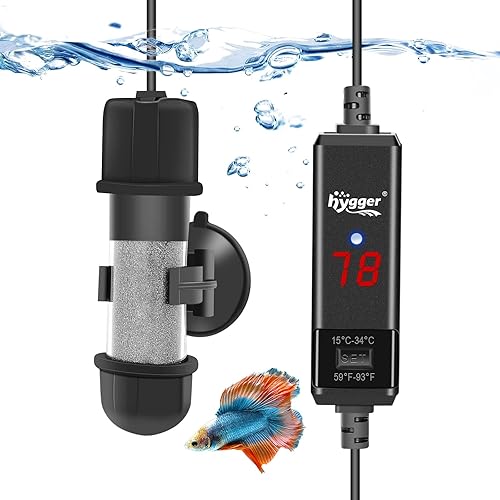
Small wattage heaters for nano tanks are harder to find reliably than the standard 50 to 200 watt range. The Hygger mini provides 25 watts in a heater body small enough to mount horizontally in a 5 gallon tank, which is often needed in tanks without enough vertical space for a full-length submersible.

The 25 watt output is the correct sizing for a 5 to 10 gallon tank in a room that stays at 65 to 70 degrees F. In colder rooms (below 60 degrees F), even a 5 gallon tank may need a 50 watt heater to maintain 78 degrees.

What buyers say

Buyers say Hygger Mini Submersible Aquarium Heater delivers on its stated purpose without hidden trade-offs in the first several uses. The group most consistently satisfied is betta tanks and nano tanks from 2 to 10 gallons, who say it handles their specific use case reliably. Where buyers recommend looking elsewhere is when you have a tank over 10 gallons.

Specifications

Specifications for Hygger Mini Submersible Aquarium Heater
Wattage25 watts
Tank size2 to 10 gallons
ThermostatAdjustable
Auto shut-offYes

Specs from Hygger, Mini Aquarium Heater product listing

04
Best in-line heater for canister filter setups
Hydor Hydor ETH In-Line External Heater

Hydor ETH In-Line External Heater

Brand: Hydor

Best for

Tanks with canister filters where you want the heater completely out of the tank and integrated into the filter's return line.

Skip if

You use a hang-on-back or sponge filter. In-line heaters require a canister filter with appropriately sized tubing.

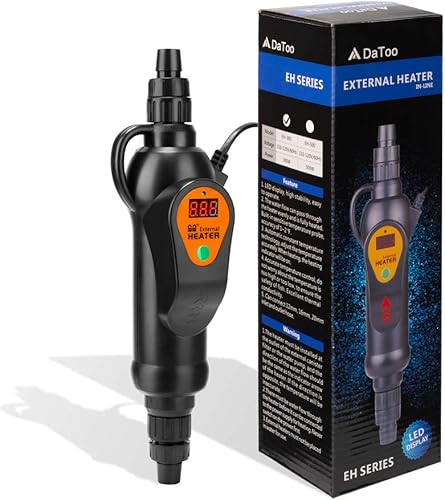
An in-line heater connects between the canister filter and its return line. Water flows through the heater on the way back to the tank, which heats it evenly at a consistent flow rate. The result is no heater inside the tank and highly consistent temperature distribution.

The primary advantage is aesthetics and space: no visible heater tube in the aquarium. The limitation is compatibility: it requires a canister filter with appropriately sized tubing.

What buyers say

Buyers point out that when you use a hang-on-back or sponge filter, a different product is the stronger fit. Outside that situation, Hydor ETH In-Line External Heater gets straightforward positive feedback from people using it as intended. For tanks with canister filters, the performance buyers report is consistently positive across the product's intended use.

Specifications

Specifications for Hydor ETH In-Line External Heater
Wattage200W (200W model for 10 to 40 gallon tanks)
PlacementExternal, connects to canister filter tubing
CompatibilityRequires 5/8 inch filter tubing

Specs from Hydor, ETH In-Line External Heater product page

Wattage sizing for small tanks

The 3 to 5 watts per gallon rule gives you a range for tank sizing:

Tank size Minimum watts Recommended watts
5 gallon 15W 25W
10 gallon 30W 50W
20 gallon 60W 100W

Use the lower end of the range in warm rooms (above 68 degrees F ambient) and the higher end in cool rooms (below 65 degrees F) or where you need a significant temperature rise (room at 65 degrees F, target tank temperature of 80 degrees F).

A heater that is too small runs continuously trying to reach the set temperature and fails sooner than one that cycles on and off as designed. When in doubt, size up by one step.

Thermostat types

Bimetal dial thermostats use a strip of metal that bends with temperature change to open and close the circuit. They are less accurate than electronic thermostats and drift over time. Temperature variance of +/- 2 degrees F is common. Adequate for hardy fish; not ideal for sensitive species.

Electronic thermostats use a digital sensor and control circuit. Variance of +/- 0.5 to 1 degree F is achievable. The Cobalt Aquatics Neo-Therm is the most widely cited example in the hobby.

Why heaters fail in small tanks

Small tanks have less water volume to buffer temperature change. A heater cycling off in a 5 gallon tank produces a more detectable temperature swing than in a 40 gallon tank. The same accuracy requirement applies to temperature dropping when the heater fails off, or temperature rising when it fails on.

The most dangerous failure is a thermostat stuck in the on position, which heats the water continuously. The practical protection is a separate thermometer with a high-temperature alarm, available in digital clip-on formats for under $10.

Placement inside the tank

Position the heater near the filter output or a circulation point so water flows past it continuously. A heater in stagnant water reads the local temperature rather than the tank's average temperature, which causes the thermostat to shut off before the whole tank has reached the set temperature.

For a hang-on-back filter, place the heater near the intake or return flow. For a sponge filter with an air-driven pump, place the heater near the output bubbles.

Compare the picks

Side by side comparison of every pick
Specification
Cobalt Aquatics Cobalt Aquatics Neo-Therm Pro Aquarium Heater
Cobalt Aquatics Neo-Therm Pro Aquarium Heater
Fluval Fluval M50 Submersible Heater
Fluval M50 Submersible Heater
Hygger Hygger Mini Submersible Aquarium Heater
Hygger Mini Submersible Aquarium Heater
Hydor Hydor ETH In-Line External Heater
Hydor ETH In-Line External Heater
Our verdictBest overall submersible heaterBest budget heaterBest for betta tanks under 5 gallonsBest in-line heater for canister filter setups
Wattage options25W, 50W, 75W, 100WNot listedNot listedNot listed
Temperature accuracy+/- 0.5 degrees FNot listedNot listedNot listed
ThermostatElectronic (not bimetal dial)Not listedAdjustableNot listed
ConstructionFlat, shatterproof casingGlass tube with protective guardNot listedNot listed
Auto shut-offPrevents overheating if run out of waterNot listedYesNot listed
WattageNot listed50 watts25 watts200W (200W model for 10 to 40 gallon tanks)
Tank sizeNot listed10 to 15 gallons2 to 10 gallonsNot listed
Temperature rangeNot listed65 to 86 degrees FNot listedNot listed
PlacementNot listedNot listedNot listedExternal, connects to canister filter tubing
CompatibilityNot listedNot listedNot listedRequires 5/8 inch filter tubing
BuyCheck priceCheck priceCheck priceCheck price

Questions people ask

How many watts do I need for a small aquarium heater?

The standard recommendation is 3 to 5 watts per gallon for tropical fish tanks. A 10 gallon tank needs 30 to 50 watts. A 5 gallon betta tank needs 15 to 25 watts. Size up if your room is consistently below 65 degrees F. Most heater failures in small tanks come from undersized heaters that run continuously, which shortens the thermostat's lifespan.

How do I know if my aquarium heater is working correctly?

Use a separate thermometer, not the heater's built-in indicator, to verify water temperature. The standard recommendation is a digital aquarium thermometer placed on the opposite end of the tank from the heater, which measures the average mixed temperature rather than the temperature directly next to the heating element. Check it daily for a week after installing a new heater to confirm the thermostat holds accurately.

Why is my aquarium heater not heating?

The thermostat may already be satisfied: if the room temperature is 78 degrees and you set the heater to 78, it will not turn on. Check that the heater is fully submerged (the minimum water level mark matters). Check that the power cord is fully plugged in and the indicator light activates when you raise the set point above the current water temperature.

Can an aquarium heater overheat and kill fish?

Yes. A heater thermostat failure in the on position can heat the water to lethal levels within hours in a small tank. This is the worst failure mode of aquarium heaters. The practical precaution is to use a heater with an auto shut-off feature, a separate thermometer with a high-temperature alarm, and to check the temperature daily.