Telescope camera for astrophotography: best picks on Amazon

Telescope cameras connect to a telescope focuser and send the image to a computer for live viewing, stacking and capture. These are the best picks on Amazon.

By Pickspry EditorialUpdated 4 picks


The short answer

The SVBONY SV305C at $149 is the best entry-level telescope camera for astrophotography: a Sony IMX662 color sensor with 2MP resolution produces planetary and lunar images at an accessible price with USB-C connection to any laptop. The SV405CC cooled camera at $599 is the best choice for deep-sky imaging where a cooled sensor dramatically reduces thermal noise in long exposures.

Product buttons open Amazon search results. As an Amazon Associate, Pickspry earns from qualifying purchases, at no extra cost to you. Learn more

Quick picks

How we chose

Telescope cameras are evaluated by sensor type and size, pixel size, cooling (cooled vs uncooled), connection type (USB-C vs USB3), pixel scale and whether the camera is optimized for planetary/lunar (high frame rate) or deep-sky (low noise, cooled). Standard DSLR cameras not designed for telescopes are excluded. Specs from manufacturer product pages. We did not test these products.

The picks, in detail

4 picks reviewed
01
Best deep-sky telescope camera
SVBONY SVBONY SV405CC Color Cooled Deep Sky Astronomy Camera

SVBONY SV405CC Color Cooled Deep Sky Astronomy Camera

Brand: SVBONY

Best for

Astrophotographers targeting nebulae, galaxies and star clusters who need a cooled camera to reduce thermal noise in long exposures, with the SV405CC's TEC cooling lowering sensor temperature by up to 35°C below ambient for clean multi-minute exposures.

Skip if

Planetary and lunar imaging is the primary goal. The SV405CC's large sensor and cooled design are optimized for long-exposure deep-sky imaging, not the high frame rate planetary capture that smaller sensor cameras like the SV305C provide. For planetary work, the SV305C is the appropriate starting camera.

The SVBONY SV405CC uses a Sony IMX571 APS-C color sensor with TEC (thermoelectric cooling) that reduces the sensor temperature up to 35 degrees Celsius below ambient temperature. Thermal noise increases with sensor temperature; at room temperature, a 5-minute exposure accumulates significant dark current noise. At -20C to -25C, the same exposure shows dramatically less thermal noise, allowing cleaner stacking of multiple exposures.

The 26MP IMX571 sensor is one of the most popular deep-sky imaging sensors available. Its large pixels (3.76 microns) and back-illuminated design provide excellent quantum efficiency, capturing more of each photon that hits the sensor.

USB-C 3.0 connection transfers the large image files quickly enough for real-time preview on a laptop. SVBONY's free astronomy software is compatible with the camera, and the SV405CC is compatible with major astronomy imaging platforms including N.I.N.A., Sequence Generator Pro and Astro Photography Tool.

What buyers say

Astrophotographers targeting nebulae say SVBONY SV405CC Color Cooled Deep Sky Astronomy Camera does what it describes without needing adjustments out of the box. Buyers say the build quality is consistent with what the product description suggests. Buyers who find themselves in a position where planetary and lunar imaging is the primary goal say a different option makes more sense for their situation.

Specifications

Specifications for SVBONY SV405CC Color Cooled Deep Sky Astronomy Camera
SensorSony IMX571 APS-C color
CoolingTEC cooled (-35C below ambient)
Resolution26MP
Price$599

Specs from SVBONY, SV405CC product page
02
Best planetary telescope camera
SVBONY SVBONY SV305C Telescope Camera for Astrophotography

SVBONY SV305C Telescope Camera for Astrophotography

Brand: SVBONY

Best for

Beginning astrophotographers who want to capture planetary and lunar images through their telescope at the most accessible price, with the Sony IMX662 color sensor providing high-speed frame capture for lucky imaging at $149.

Skip if

Long-exposure deep-sky imaging is planned. The SV305C is an uncooled planetary camera optimized for high frame rate capture at short exposures. For nebulae and galaxies requiring multi-minute exposures, the thermal noise on an uncooled sensor limits image quality. The SV405CC cooled camera is the appropriate choice for deep-sky work.

The SVBONY SV305C uses the Sony IMX662 back-illuminated color sensor with a pixel size of 2.9 microns. The back-illuminated design improves low-light sensitivity compared to front-illuminated sensors by exposing the photodiodes directly to incoming photons without the readout circuitry blocking them.

Planetary imaging uses a different technique than deep-sky imaging: capture thousands of short-exposure frames at high frame rate, then use software such as AutoStakkert (free) to select the sharpest frames from atmospheric seeing variations and stack them. The SV305C's 130fps capture rate at 1920x1080 provides sufficient frame count per session for effective lucky imaging.

At $149, the SV305C is the most accessible dedicated astronomy camera on Amazon that provides both planetary and guided deep-sky capability. It replaces a phone held to the eyepiece with a proper USB-C telescope camera that fits in the 1.25-inch focuser.

What buyers say

Most buyers fitting the profile of beginning astrophotographers who want to capture planetary report SVBONY SV305C Telescope Camera for Astrophotography meets their expectations across regular use. Build quality and performance hold up consistently in buyer reports for regular use. The common reason buyers pass on it is when long-exposure deep-sky imaging is planned.

Specifications

Specifications for SVBONY SV305C Telescope Camera for Astrophotography
SensorSony IMX662 color
Frame rateUp to 130fps at full resolution
ConnectionUSB-C 3.0
Price$149

Specs from SVBONY, SV305C product page

03
Best wireless telescope camera
Smart wireless 4K Wireless Telescope Camera for Astrophotography

4K Wireless Telescope Camera for Astrophotography

Brand: Smart wireless

Best for

Telescope users who want to view and capture images on a smartphone or tablet without running a cable from the telescope to a laptop, using a wireless connection from the camera to any device with the companion app installed.

Skip if

Image quality over convenience is the priority. Wireless telescope cameras at this price range use compressed WiFi video streams that reduce image quality compared to direct USB-C cameras. For maximum image quality for planetary or deep-sky imaging, a wired USB-C camera provides a higher-quality uncompressed data stream.

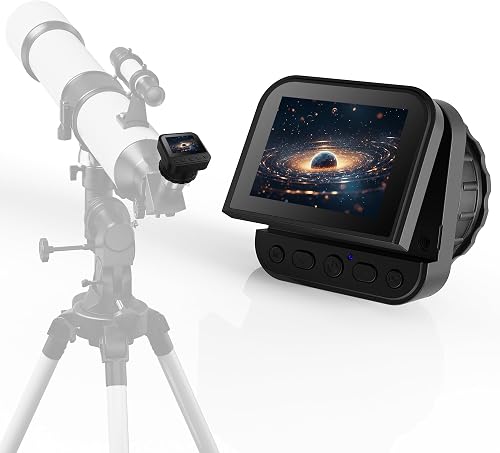
The 4K wireless telescope camera connects to a telescope's 1.25-inch focuser and broadcasts its image over WiFi to a smartphone or tablet. This eliminates the need for a laptop at the telescope, which simplifies the setup and allows sharing the live view with multiple people simultaneously on their own devices.

The wireless connection is practical for casual astrophotography and family viewing where sharing the screen is more important than maximum image quality. Parents introducing children to astronomy can show the live view on a tablet that children can see without taking turns at the eyepiece.

At $159, the wireless camera sits just above the SV305C wired planetary camera in price. For buyers where the wireless convenience justifies the image quality trade-off, the wireless camera provides a more social and portable observation experience.

What buyers say

Buyers say 4K Wireless Telescope Camera for Astrophotography delivers on its stated purpose without hidden trade-offs in the first several uses. The group most consistently satisfied is telescope users who want to view, who say it handles their specific use case reliably. Where buyers recommend looking elsewhere is when image quality over convenience is the priority.

Specifications

Specifications for 4K Wireless Telescope Camera for Astrophotography
Resolution4K
ConnectionWiFi to smartphone or tablet
Compatibility1.25-inch focuser
Price$159

Specs from 4K Wireless Telescope Camera, Amazon search

04
Best planetary camera for SCT telescopes
Celestron Celestron NexImage 20 Solar System Imager

Celestron NexImage 20 Solar System Imager

Brand: Celestron

Best for

Celestron telescope owners who want an officially supported planetary camera from the same brand, with Celestron's NexImage software included and a 5MP sensor optimized for Moon, Sun and planetary capture.

Skip if

Deep-sky nebulae and galaxies are the imaging goal. The NexImage 20 is optimized for high-surface-brightness solar system targets. For deep-sky imaging, a long-exposure capable camera with an equatorial mount is required. The NexImage 20 does not provide the long-exposure capability needed for nebulae or galaxies.

The Celestron NexImage 20 is Celestron's flagship planetary camera, designed specifically for capturing the Moon, planets and the Sun with the included software. The 5MP sensor captures detailed lunar surface images and planetary disc detail in seeing-limited conditions.

Celestron's included software provides a complete workflow for planetary imaging: live capture, frame selection and stacking without requiring third-party software. For buyers who want a single-brand solution with Celestron's telescope, the NexImage 20's software integration simplifies the learning curve.

At $449, the NexImage 20 is priced above the SVBONY SV305C. The premium reflects Celestron's brand, the included software and the 5MP resolution versus the SV305C's 2MP. For Celestron telescope owners who value brand consistency and the included software, the NexImage 20 provides the complete planetary imaging experience within the Celestron ecosystem.

What buyers say

Buyers point out that when deep-sky nebulae and galaxies are the imaging goal, a different product is the stronger fit. Outside that situation, Celestron NexImage 20 Solar System Imager gets straightforward positive feedback from people using it as intended. For celestron telescope owners who want an officially supported planetary camera from the same brand, the performance buyers report is consistently positive across the product's intended use.

Specifications

Specifications for Celestron NexImage 20 Solar System Imager
Sensor resolution5MP
TargetMoon, planets, Sun with filter
SoftwareCelestron NexImage included
Price$449

Specs from Celestron, NexImage 20 product page

Two types of telescope cameras

Telescope cameras serve two distinct purposes with different requirements:

Planetary cameras (high frame rate):

  • Short exposures (1-10 ms) capture planetary and lunar detail
  • High frame rate (100-200 fps) provides large sample for stacking
  • Small sensors focus on the planet disc, not wide field
  • Best targets: Moon, Saturn, Jupiter, Mars, double stars

Deep-sky cameras (low noise, long exposure):

  • Long exposures (1-20 minutes per frame) accumulate faint nebula light
  • Cooled sensors reduce thermal noise in long exposures
  • Larger sensors capture more sky area per frame
  • Best targets: Nebulae, galaxies, star clusters, the Milky Way

The same camera cannot optimally serve both purposes. Beginners often start with a planetary camera and add a cooled camera later for deep-sky work.

Sensor comparison

Camera Sensor Best for Price
SV305C IMX662 2MP Planetary and lunar $149
4K wireless 4K Casual viewing, sharing $159
NexImage 20 5MP Moon, solar system $449
SV405CC IMX571 26MP cooled Deep-sky nebulae $599

Lucky imaging explained

Atmospheric turbulence (seeing) causes stars and planets to appear to shimmer. At any given moment, a fraction of frames captured during a planetary session show sharper detail than others when the atmosphere briefly steadies.

Lucky imaging captures hundreds to thousands of frames in a session and selects only the sharpest percentage for stacking. Software analyzes each frame for sharpness and discards the blurry majority. The stacked result combines the best detail from many favorable moments.

The SV305C at 130fps captures 7,800 frames in a 60-second session. Selecting the top 10% provides 780 frames for stacking - far more than any single long exposure can provide.

Compare the picks

Side by side comparison of every pick
Specification
SVBONY SVBONY SV405CC Color Cooled Deep Sky Astronomy Camera
SVBONY SV405CC Color Cooled Deep Sky Astronomy Camera
SVBONY SVBONY SV305C Telescope Camera for Astrophotography
SVBONY SV305C Telescope Camera for Astrophotography
Smart wireless 4K Wireless Telescope Camera for Astrophotography
4K Wireless Telescope Camera for Astrophotography
Celestron Celestron NexImage 20 Solar System Imager
Celestron NexImage 20 Solar System Imager
Our verdictBest deep-sky telescope cameraBest planetary telescope cameraBest wireless telescope cameraBest planetary camera for SCT telescopes
SensorSony IMX571 APS-C colorSony IMX662 colorNot listedNot listed
CoolingTEC cooled (-35C below ambient)Not listedNot listedNot listed
Resolution26MPNot listed4KNot listed
Price$599$149$159$449
Frame rateNot listedUp to 130fps at full resolutionNot listedNot listed
ConnectionNot listedUSB-C 3.0WiFi to smartphone or tabletNot listed
CompatibilityNot listedNot listed1.25-inch focuserNot listed
Sensor resolutionNot listedNot listedNot listed5MP
TargetNot listedNot listedNot listedMoon, planets, Sun with filter
SoftwareNot listedNot listedNot listedCelestron NexImage included
BuyCheck priceCheck priceCheck priceCheck price

Questions people ask

Do I need a special camera to take photos through a telescope?

No, but a dedicated astronomy camera produces better results than a phone or standard DSLR for most telescope photography. A phone held to the eyepiece captures images through the eyepiece optics but produces lower quality than a camera that replaces the eyepiece and connects directly to the telescope's focal plane. A dedicated telescope camera fits in the focuser like an eyepiece and sends its signal by USB-C or WiFi to a laptop or phone. For casual Moon and bright planet photography, a phone adapter that holds the phone to the eyepiece provides accessible results. For serious astrophotography of any kind, a dedicated telescope camera provides significantly better image quality.

What is the difference between a cooled and uncooled astronomy camera?

Cooled astronomy cameras use a thermoelectric cooler (TEC) to lower the sensor temperature below ambient, reducing thermal dark current noise that accumulates during long exposures. An uncooled sensor at 20 degrees Celsius produces significantly more thermal noise in a 5-minute exposure than a cooled sensor at -15 degrees Celsius. For planetary imaging where exposures are under 1 second, cooling provides little benefit because thermal noise does not accumulate significantly in short exposures. For deep-sky imaging of nebulae and galaxies where exposures run 5-20 minutes per frame, a cooled camera produces dramatically cleaner images that stack better. Budget cooled cameras start at $500-$600; uncooled cameras are $100-$300.

What software do I need to use a telescope camera?

For planetary imaging: SharpCap (Windows, free and paid versions) or FireCapture (free) for capture, AutoStakkert (free) for frame selection and stacking, RegiStax or WinJupos for final processing. For deep-sky imaging: N.I.N.A. (free) for capture and sequencing, PixInsight (paid) or Siril (free) for calibration, stacking and processing. Most dedicated astronomy cameras include their own basic software, which is sufficient for beginning capture. Third-party software provides more control and is widely used by experienced astrophotographers. SharpCap alone provides live planetary capture and basic stacking for beginners without additional software.